
A solid state version of the CMD regulator has been designed by a member of the Keighley and Worth Valley Railway team. The circuit diagram is shown here.
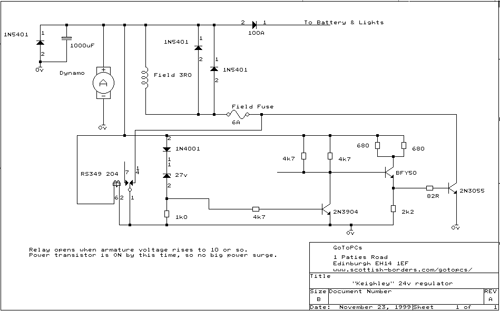
When the dynamo is at rest, or just rotating slowly, insufficient voltage is produced to open the relay,
so the field coil remains connected to 0v. This way, maximum power from the armature is fed into the field
coil, thus generating maximum voltage as the generator speeds up. When the dynamo is generating 6 volts or
so, there is sufficient voltage to turn on the power transistor (2N3055 or equivalent), so when the voltage
rises further, and the relay switches, the short to 0v at the bottom of the field coil is maintained through
the power transistor. This means that a light duty relay can be used, as no great power is switched.
When the armature output exceeds the battery voltage, charging power flows through the 100A diode. If the
voltage continues to rise, current will begin to flow through the 27v zener diode. This switches on the
2N3904 transistor which in turn switches the BFY50 off. The power to the 2N3055 is so removed and the
current flowing through the field coil drops. This causes the charging current from the dynamo armature
to drop also, hence regulation is achieved.
No moving parts, so maximum reliability.
Note that this type of regulator is only suitable for controlling W or WA series dynamos which have a
field resistance of about 9 ohms. The maximum current the regulator has to handle is then 28/9=3.1 amps.
The WC dynamo (usually found in buffet vehicles with a larger load) has a field resistance of approximately
2.5 ohms. The maximum field current is then 28/2.5=11.2 amps. Rather too much for a 6 amp fuse!